
Reading time: 5 minutes
After losing a pregnancy, an unexpected blood test result can bring both hope and worry. If your report says “ANA positive” but you have never been diagnosed with an autoimmune disease, you may wonder whether you have finally found an explanation – and whether you need treatment before trying again.
The answer depends on the details of the result, your other findings and your pregnancy history. A positive ANA test alone cannot establish why a miscarriage happened. When it occurs alongside other immune abnormalities, however, it may warrant a more detailed assessment.
Can I have autoantibodies without having an autoimmune disease?
Yes. Antinuclear antibodies, or ANA, recognise components of the body’s own cells. They can be found in people with autoimmune diseases, but also in healthy people, particularly at lower titres.
A positive result does not automatically mean lupus or another systemic autoimmune disease. A laboratory finding and a clinical diagnosis are different things.
Some women have several positive autoantibodies or other immune abnormalities without clear symptoms of an established disease. Researchers in reproductive immunology are investigating whether particular combinations of these findings are relevant to pregnancy outcomes, and whether carefully selected patients might benefit from treatment. These questions remain open.
What does an ANA result of 1:100 mean?
The number describes the dilution at which antibodies can still be detected. A result that is positive at a lower dilution differs from one that remains positive when the sample is diluted much further.
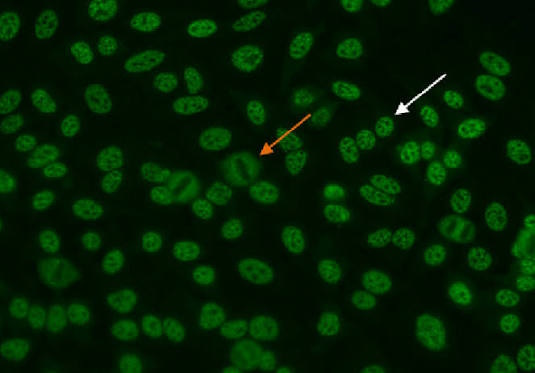
A low-positive result does not, by itself, establish a hidden autoimmune condition. Equally, a high titre alone does not establish a diagnosis. The fluorescence pattern — such as a speckled pattern — and any specific autoantibodies also matter. These findings need to be considered alongside symptoms, medical history and other test results. Two women whose reports both say “ANA positive” may therefore need different advice.
Why might other immune tests be considered?
When there is a clinical reason to investigate further, an assessment may extend beyond ANA.
A recent study of women with recurrent pregnancy loss examined autoantibody profiles, immunoglobulins and complement. The researchers were particularly interested in women who had several immune abnormalities without a diagnosed systemic autoimmune disease.
The findings considered included:
- Specific autoantibodies: anti-SSA/Ro, anti-SSB/La, anti-Ro52, anti-U1RNP and anti-Sm, as well as anti-Jo-1, anti-Mi-2, anti-Scl-70 and anti-centromere protein B antibodies, or anti-CENP-B.
- Other autoimmune tests: rheumatoid factor (RF), anti-cyclic citrullinated peptide antibodies (anti-CCP) and antineutrophil cytoplasmic antibodies (ANCA), which were mentioned within the immune assessment.
- Antiphospholipid tests: anticardiolipin antibodies, anti-beta-2-glycoprotein I antibodies and lupus anticoagulant.
- Immunoglobulins and complement: immunoglobulins G, A and M (IgG, IgA and IgM), and complement components C3 and C4.
These tests do not all have the same purpose or the same strength of evidence linking them to pregnancy loss (RPL). Some primarily help identify a particular autoimmune disease. For others, researchers are still investigating whether they can contribute to reproductive risk assessment.
Immunoglobulin levels and complement measurements are not autoantibody tests; they provide different information about the immune system. This is therefore not a checklist of tests every woman should have. Each investigation should address a specific clinical question.
What did the recent study find?
In a retrospective study published in 2026, researchers compared pregnancy outcomes in women with recurrent pregnancy loss and positive immune findings who received hydroxychloroquine, prednisone and aspirin with outcomes in women who did not receive that combination.
Treatment in the intervention group began before attempts to conceive. The authors reported better pregnancy outcomes in that group.
The observation is worth investigating, but it does not establish that the medication caused the improvement. The women were not randomly assigned to treatment, and inconsistencies in the reporting of outcomes make the size of any benefit difficult to interpret. The study also did not assess adverse pregnancy outcomes associated with the medication regimen.
The wider evidence matters too. Larger studies have found that ANA positivity alone does not necessarily predict a lower chance of live birth in a subsequent pregnancy. These findings should not be interpreted as a recommendation to treat every woman who has a positive ANA result.
Can an assessment begin before conception?
Yes. A reproductive immunology consultation can take place before you try to conceive again. This allows time to review your previous investigations, decide whether anything needs clarification and agree on a plan.
If treatment is indicated, some preparation may begin before conception. However, having a consultation does not mean medication will be necessary.
Immune assessment should be considered alongside the gynaecological and other investigations relevant to pregnancy loss. A positive immune result should not automatically be assumed to explain previous miscarriages.
How do we decide whether treatment is appropriate?
Treatment decisions in a woman with an established autoimmune disease or antiphospholipid syndrome have a different evidence base from decisions involving an isolated positive ANA result.
When the significance of the findings is uncertain, your consultation should explain what they may mean in your circumstances, what any proposed treatment aims to achieve, how reliable the evidence is and what risks or alternatives need to be considered.
Shared decision-making may lead to further investigations, monitoring or, in selected circumstances, consideration of treatment. If a medicine is being proposed outside its approved indication, this should also be explained. An individualised approach includes a clear explanation of why medication may not be needed.
Planning your next pregnancy?
If you have experienced recurrent pregnancy loss and have a positive ANA test or other immune abnormalities, a preconception consultation can help you understand the findings and plan your next steps.
You can book a reproductive immunology consultation at Immuno Center before trying to conceive. Please bring records of your previous pregnancies and investigations so that your assessment can take your full history into account.
Reference:
Xie and colleagues. Associations of Nonspecific Autoantibodies with Recurrent Pregnancy Loss and Pregnancy Outcomes Following Immunological Intervention: A Single-Centre Retrospective Cohort Study. ImmunoTargets and Therapy, 2026. https://doi.org/10.2147/ITT.S630100